
Search Tulsa Deed Records
Tulsa deed records are filed at the county level, not at city hall. Most Tulsa properties fall in Tulsa County, though some parts of the city extend into Osage, Rogers, and Wagoner counties. The Tulsa County Clerk runs the Land Records Division and keeps all deeds, mortgages, liens, and plats for property within its borders. Searching for Tulsa deed records starts with the county clerk's online portal. You can also visit the office in downtown Tulsa to pull documents in person. For properties near the city edge, check which county holds the records before you start your search.
Tulsa Deed Records Overview
Tulsa County Clerk and Tulsa Deed Records
The Tulsa County Clerk is the main office for Tulsa deed records. County Clerk Michael Willis runs the Land Records Division from 500 S Denver Ave, 2nd Floor, Tulsa, OK 74103. His office records deeds, mortgages, liens, plats, and all other land documents for property in the Tulsa County portion of the city. Since most of Tulsa sits in this county, this is where the bulk of deed searches happen. Call (918) 596-5800 or email landrecords@tulsacounty.org with questions about filings.
The Land Records Division offers online search tools through countyclerk.tulsacounty.org. You can look up records by name, document type, instrument number, or recording date. The system is free to search. Scanned images of recorded documents are available for viewing on screen. For in-person visits, bring the name on the deed, the legal description, or the instrument number. Staff can pull what you need fast if you have good search info. Plain copies cost $1.00 per page. Certified copies add $1.00 more per document.
| Tulsa County Clerk Contact | |
|---|---|
| Clerk | Michael Willis |
| Address | 500 S Denver Ave, 2nd Floor, Tulsa, OK 74103 |
| Phone | (918) 596-5800 |
| landrecords@tulsacounty.org | |
| Online Portal | countyclerk.tulsacounty.org |
The screenshot below shows the Tulsa County Clerk Land Records Division portal where Tulsa property owners can search deed records online.
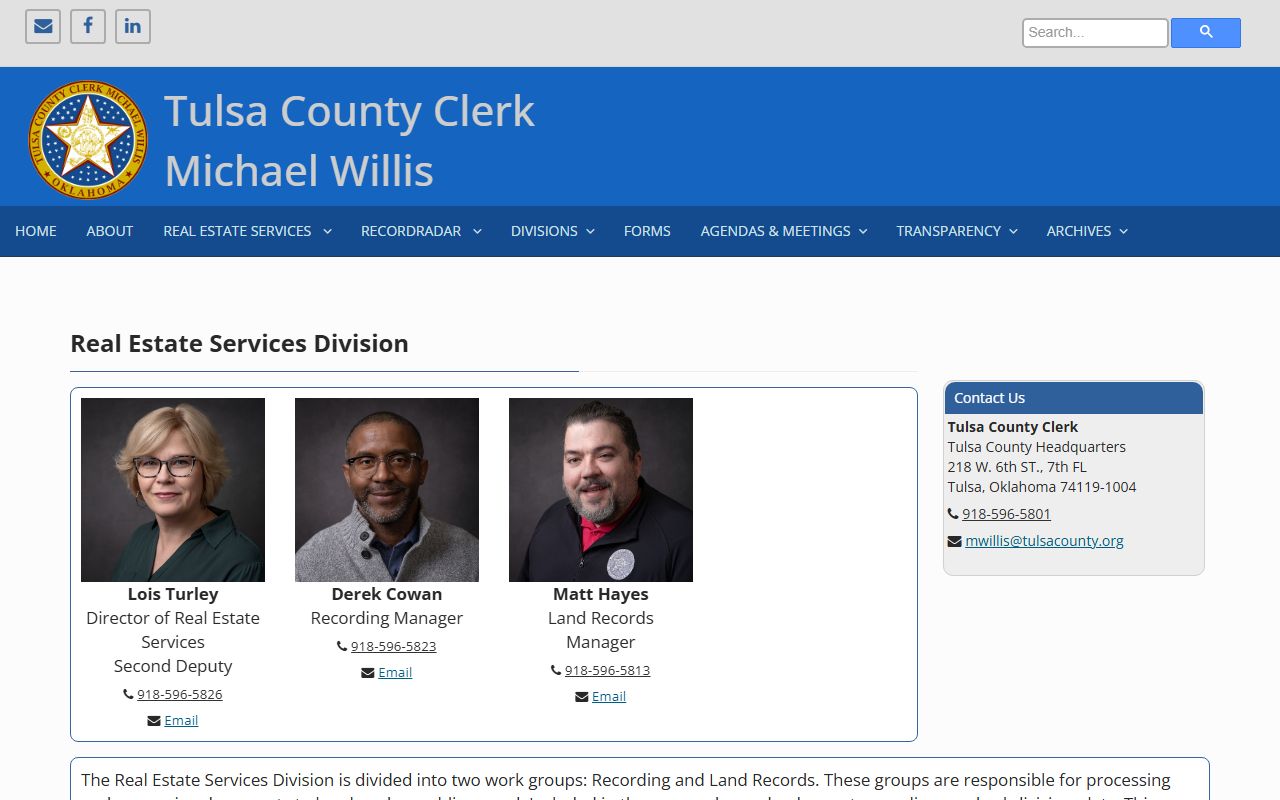
The portal covers all document types that get filed with the clerk. Warranty deeds, quit claim deeds, mineral deeds, mortgages, releases, and liens all show up in search results. Tulsa County also supports e-filing for submitters who want to record documents electronically.
Tulsa County LOCCAT Map Search
Tulsa County runs a mapping tool called LOCCAT. It ties property data to geographic locations. You can search by address, parcel number, or map location to find land records tied to a specific piece of property. LOCCAT pulls together assessor data, zoning info, and recorded documents in one view. For deed research in Tulsa, it gives you a quick way to see who owns a parcel, what the legal description is, and when the last transfer happened.
The map-based search works well for buyers and title researchers who want to check a property without knowing the exact instrument number. You can zoom in on a location and click the parcel to pull up its record. The tool is free. It runs through the Tulsa County website. Pair it with the Land Records portal for a full picture of any Tulsa deed record.
RecordRadar Fraud Alerts for Tulsa Deed Records
Tulsa County offers RecordRadar. It is a free fraud alert service. When you sign up, the clerk's office sends you a notice any time a document gets filed with your name on it. This catches forged deeds, fake mortgage releases, and unauthorized lien filings before they cause real harm to your property title.
Property fraud has grown across Oklahoma in recent years. Someone files a forged quit claim deed and tries to sell a home they do not own. Tulsa homeowners can protect themselves by enrolling in RecordRadar through the Tulsa County Clerk website. The service is free and takes just a few minutes to set up. You pick what names you want monitored. Any time a recording hits the system with that name, you get an email alert right away.
The screenshot below shows the RecordRadar signup page for Tulsa County deed records fraud protection.
Setting up alerts is one of the easiest ways to guard your Tulsa property. The clerk's office recommends it for all homeowners in the county.
Multiple Counties Serve Tulsa Properties
Tulsa stretches beyond Tulsa County. Small parts of the city reach into Osage County, Rogers County, and Wagoner County. Where your property sits determines which clerk's office holds the deed records. A deed filed in the wrong county has no legal effect on the property. Getting this right matters.
For Osage County, the clerk handles records through the statewide OKCountyRecords.com portal. Rogers County also uses the statewide system. Wagoner County has its own website at wagonercounty.ok.gov and the Wagoner County Clerk can be reached at (918) 485-2216. If you are not sure which county a Tulsa property falls in, check the legal description against county boundary maps. The Tulsa County Assessor's LOCCAT tool can help you figure out the right jurisdiction.
Most Tulsa deed searches will go through Tulsa County. But if a property sits near the northern or eastern city limits, double-check before you file or search. A trip to the wrong courthouse wastes time and fees.
Tulsa Deed Recording Fees
Recording fees for Tulsa deed records follow the state schedule under Oklahoma Statutes Title 28, Section 32. The base rate is $8.00 for the first page of a conforming document. A $10.00 preservation fee gets added on top. That makes the total first-page cost $18.00. Each page after the first costs $2.00. So a three-page warranty deed in Tulsa runs $22.00 to record.
Non-conforming documents cost more. The first page jumps to $35.00 for non-conforming filings. Each added page runs $10.00. A document gets flagged as non-conforming if it has wrong margins, is hard to read, or exceeds the 8.5 by 14 inch size limit. Since November 2024, documents need a 2-inch top margin and 1-inch margins on all other sides. Missing these specs triggers the higher fee.
Plats have separate rates. One block or less costs $20.00. More than one block is $35.00. Copies of plats run $5.00 each. Every deed filed in Tulsa must include documentary stamps or an exemption stamp. An Alien Land Ownership Affidavit from the Oklahoma Attorney General's website must be attached to every deed since November 2023, per 60 O.S. Section 121.
Note: Tulsa County supports e-filing for deed records, which can speed up processing time for title companies and law firms.
How to Search Tulsa Deed Records
Start at the Tulsa County Clerk Land Records portal. Go to countyclerk.tulsacounty.org and search by name, instrument number, or document type. The search is free. Results show the recording date, document type, parties involved, and instrument number. You can view scanned images of the filed documents right on the site.
For a broader search, the Oklahoma State Courts Network covers court records that can affect property title. Judgment liens, foreclosure cases, and lis pendens filings all show up on OSCN. The USLandRecords platform covers some Oklahoma counties as well. Under Oklahoma Statutes Title 16, Section 16, a filed deed serves as constructive notice to all future buyers and creditors. That is why checking deed records before any Tulsa property deal matters.
If you need older records or documents not yet scanned, call the clerk's office at (918) 596-5800. Staff can run manual searches through the older indexes. Mail or email requests also work. Give them the name, legal description, or as much detail as you can. Turnaround depends on the volume of requests at that time.
Tulsa City Clerk and Open Records
The Tulsa City Clerk does not handle deed records. That is the county's job. But City Clerk Christina Chappell manages municipal records that can be useful during property transactions. Her office is at 175 E 2nd St, Suite 260, Tulsa, OK 74103. Call (918) 596-7513 or email cityclerk@cityoftulsa.org for questions about city records.
Tulsa has an open records request portal at tulsaok.justfoia.com. You can submit requests for building permits, zoning records, code violation history, and other municipal documents through the site. Under Title 51, Section 24A.5 of the Oklahoma Open Records Act, public bodies must give prompt and reasonable access to records. The City Clerk processes all such requests for Tulsa city departments.
Building permits and zoning actions can matter for deed research. A buyer might want to check what work was done on a property. Code violations tied to a parcel sometimes show up during title searches. The city clerk's office can point you to the right department even though they do not touch deed filings directly.
Tulsa Deed Filing Requirements
Every deed filed for Tulsa property must meet state format rules. Paper size cannot go past 8.5 by 14 inches. Top margins need 2 inches. All other sides need at least 1 inch. Text must be in English and clear enough to read. The document needs proper notarization, all required signatures, and the grantee's mailing address. Under Title 67 of the Oklahoma Statutes, the county clerk serves as the ex officio register of deeds.
Each document gets an instrument number and a book-and-page reference when filed. The clerk keeps at least two copies in separate locations. Documentary stamps or an exemption stamp are required on all deeds. Missing any of these items means the clerk will reject the filing or charge non-conforming rates. Tulsa County's e-filing option lets submitters send documents electronically, which can cut processing time for high-volume filers like title companies.
Nearby Cities
Several cities near Tulsa also have deed records pages on this site. Broken Arrow is southeast of Tulsa and straddles Tulsa and Wagoner counties. Owasso is north of Tulsa, mostly in Tulsa County with a portion in Rogers County. Bixby sits south of Tulsa in Tulsa County. Jenks is just southwest of the city, also in Tulsa County.
Deed records are filed by county, not by city. A Tulsa property in Wagoner County goes through the same clerk office as a Broken Arrow property in that county. A Tulsa parcel in Rogers County gets filed at the same office that handles Owasso records. Always check the county before you file or search.
Tulsa deed records are primarily maintained by Tulsa County, with portions in Osage County, Rogers County, and Wagoner County.