
Oklahoma Deed Records
Oklahoma deed records are public land documents kept by each of the 77 County Clerk offices across the state. You can search for deeds, mortgages, liens, and other property filings online or in person at the courthouse. The free statewide portal at OKCountyRecords.com gives you access to over 27 million indexed land records and 93 million scanned images from 66 counties. For counties not on that system, like Oklahoma County and Tulsa County, each one runs its own search portal. If you need a certified copy of a deed or want to look up a past land transfer, the County Clerk in the county where the property sits is where you start. Most offices are open Monday through Friday and can pull records by name, legal description, or instrument number.
Oklahoma Deed Records Overview
Where to Find Oklahoma Deed Records
The County Clerk is the main source for deed records in Oklahoma. Each county has its own clerk who acts as the ex officio Register of Deeds. That office handles all land record filings. They store deeds, mortgages, liens, plats, oil and gas leases, easements, and many other property documents. When you buy or sell land in Oklahoma, the deed gets filed at the County Clerk in the county where the land sits. Once filed, it becomes a public record. Anyone can ask to see it or get a copy. You do not need to own the property or be named on the deed to request it.
Oklahoma runs a decentralized system. There is no single state office that holds all deed records. Each of the 77 counties keeps its own files. Some go back to pre-statehood days before 1907. The good news is that most counties now have digital records you can search from home. The statewide portal at OKCountyRecords.com covers 66 counties and lets you search by name, subdivision, section-township-range, or document number. The remaining 11 counties run their own systems. Oklahoma County uses OKCC.online, Tulsa County has its own land records division at countyclerk.tulsacounty.org, and Canadian County runs a search portal at search.cogov.net.
You can also find property-related court records through the Oklahoma State Courts Network. That system shows judgment records, lis pendens, and foreclosure cases that can affect a property title.
The screenshot below shows the main page of the OKCountyRecords.com statewide portal where you can begin searching Oklahoma deed records across most counties.
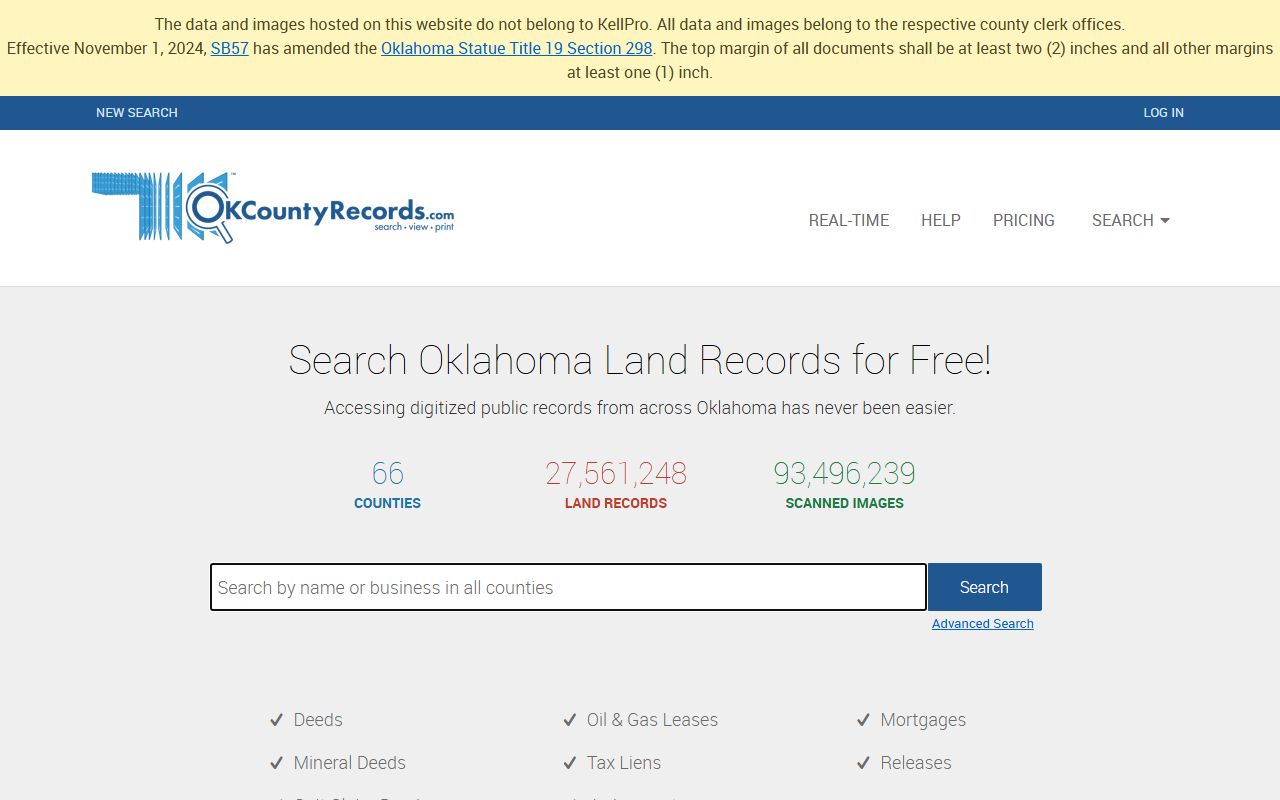
That portal is free to use. It gets updated as counties submit new records.
How to Search Deed Records in Oklahoma
Searching Oklahoma deed records online starts with knowing what county the property is in. Once you know the county, head to OKCountyRecords.com if that county is on the statewide portal. Pick the county from the dropdown and choose your search method. You have four ways to look things up.
The first is a name search. Type in a last name and first name in "Last, First" format. Pick whether you want to search by grantor, grantee, or both. You can also set a date range and filter by instrument type. This works well when you know who bought or sold a piece of land. The second method is a subdivision search. Enter the subdivision name and you can add a lot number or block number to narrow things down. The third method uses the Section-Township-Range system that is common in Oklahoma land descriptions. Enter the section number (1 through 36), the township with a directional like "10N," and the range like "5W." The fourth method lets you search by document information if you have an instrument number or book and page numbers.
Search results come back in a table format. You see the county, recorded date, instrument number, document type, book and page, grantor and grantee names, a short legal description, and a link to view scanned images. Many records include full page scans you can view right on the screen.
For in-person searches, visit the County Clerk during business hours. Most offices are open 8:00 AM to 4:30 PM on weekdays. Bring the property address, legal description, or owner name. Staff can pull up records and make copies. Plain copies run about $1.00 per page. Certified copies cost $1.00 per page plus a certification fee.
Here is a look at the USLandRecords platform, which gives you another way to search Oklahoma deed records online through a commercial interface.
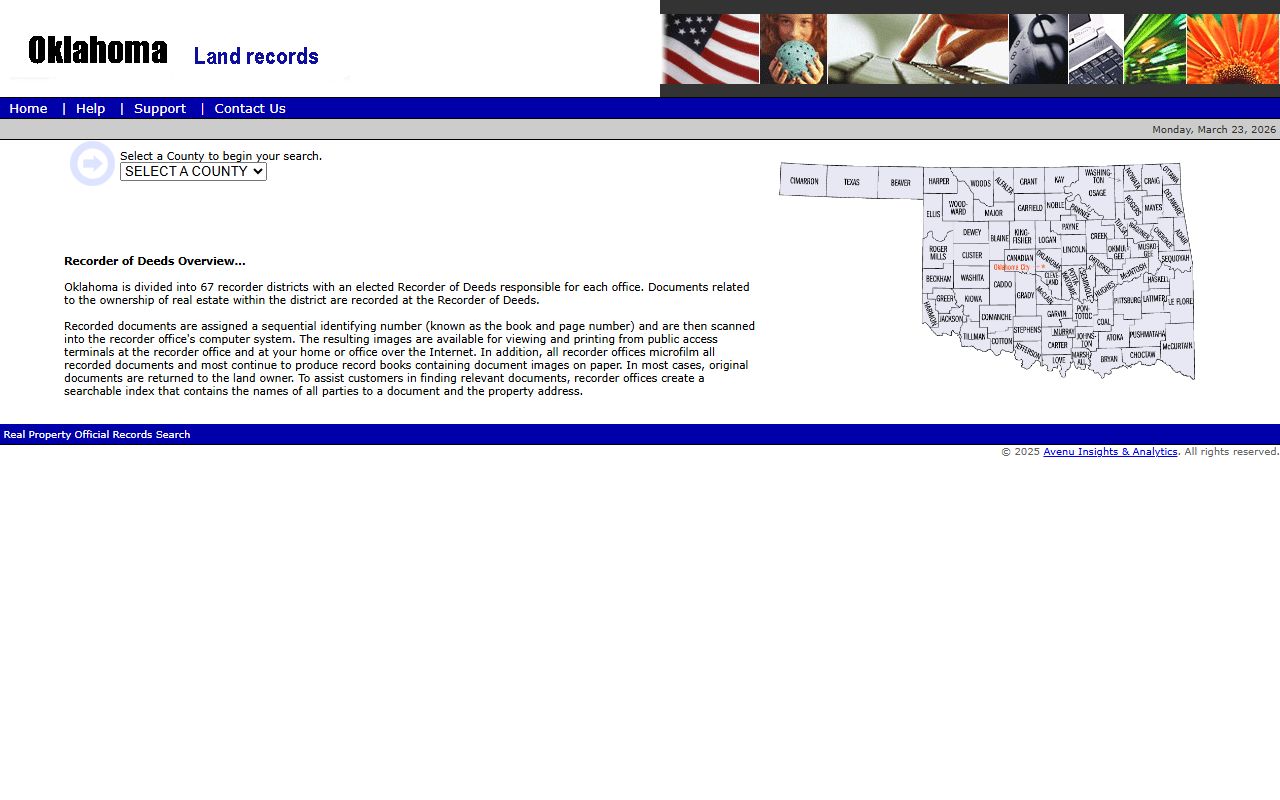
USLandRecords covers many Oklahoma counties and organizes records by book and page numbers.
Types of Oklahoma Deed Records
Oklahoma deed records cover a wide range of property documents. The most common is the warranty deed. It transfers ownership and includes a promise that the seller holds clear title. A special warranty deed limits that promise to only the time the seller owned the land. A quit claim deed transfers whatever interest the seller may have with no guarantees at all. Joint tenancy deeds set up shared ownership where the last surviving owner gets the whole property.
Beyond deeds, the County Clerk also files mortgages, assignments of mortgage, and releases of mortgage. You will find mineral deeds and royalty deeds, which are common in Oklahoma because of the state's oil and gas industry. Oil and gas leases are filed here too. The system also handles liens of all types. That includes mechanic's liens, materialmen's liens, federal tax liens, state tax liens, and judgment liens. Lis pendens notices that signal pending lawsuits over a property go through the County Clerk as well.
Other documents in the deed records system include:
- Transfer on Death Deeds that pass property to a named person when the owner dies
- Personal representative deeds from estate proceedings
- Trustee deeds and sheriff's deeds from forced sales
- Easements and right-of-way filings
- Plat maps and subdivision records
- UCC financing statements tied to real property
- Powers of attorney and affidavits related to land
Each document gets assigned an instrument number and a book and page reference when filed. That numbering system makes it possible to track the full chain of title for any piece of land in the state.
Note: Under Oklahoma Statutes Title 16, Section 15, a deed is valid between the parties even without recording, but it is not valid against third parties unless acknowledged and recorded.
Oklahoma Deed Recording Rules
Filing a deed in Oklahoma means meeting specific format and content rules. The document must be an original or certified copy. It has to be in English and clearly readable without a magnifying glass. Paper size can be no larger than 8.5 by 14 inches. Margins matter too. You need at least 2 inches at the top and 1 inch on the sides and bottom. The deed must include the full names and signatures of all grantors, the names and mailing addresses of all grantees, a specific legal description of the property, and a notary acknowledgment with seal.
Documents that do not meet format rules are called "non-conforming." They can still be filed, but the fees are much higher. A conforming deed costs $8.00 for the first page and $2.00 for each page after that, as set by Oklahoma Statutes Title 28, Section 32. A non-conforming document runs $25.00 for the first page and $10.00 for each added page. Every document also carries a $10.00 records preservation fee. That money goes toward maintaining and digitizing county records.
Since November 2023, all deeds must include an Alien Land Ownership Affidavit for each grantee, as required by 60 O.S. Section 121. Forms for this are on the Oklahoma Attorney General's website. There are separate forms for individuals and for business entities or trusts. County clerks will not accept a deed without this affidavit unless an exemption applies and is shown on the face of the deed.
The Cleveland County Clerk page shown below is one example of a county office that handles Oklahoma deed records, including forms and fee schedules for recording property documents.
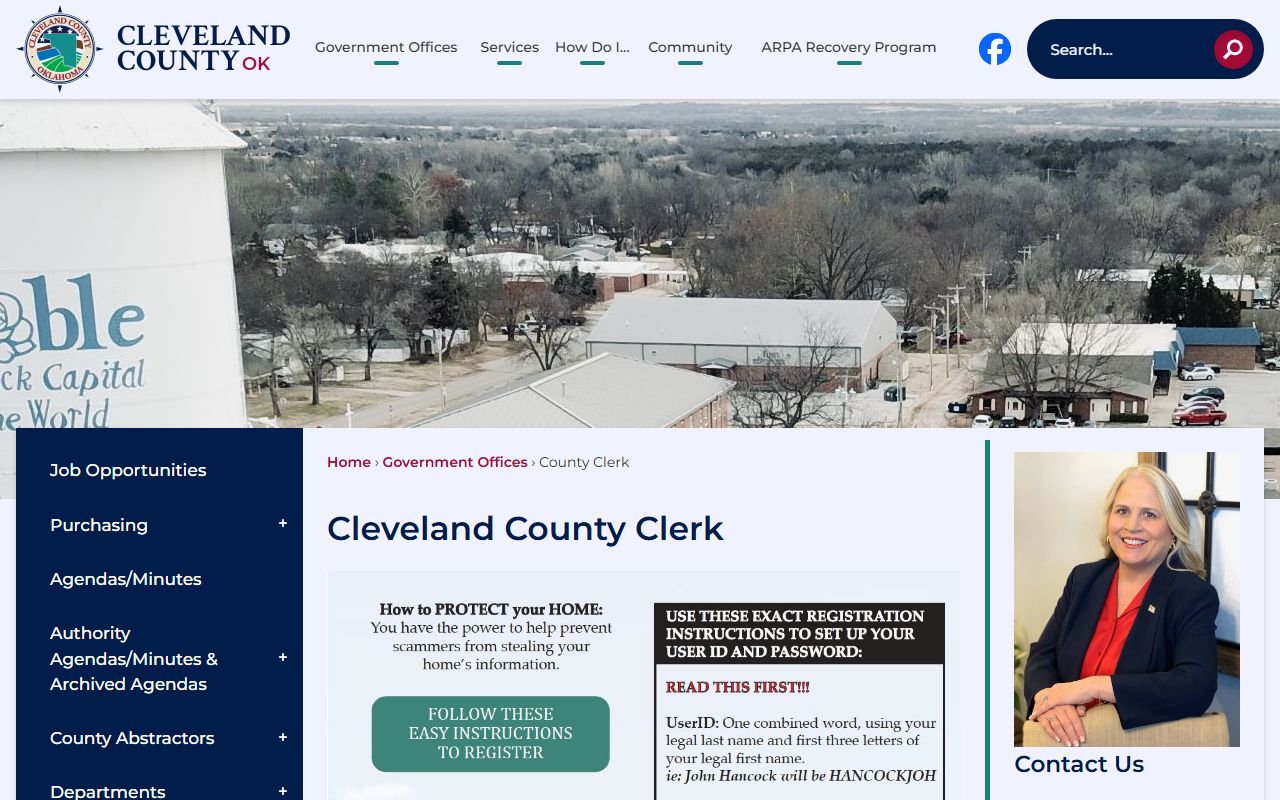
Exemptions include deeds that correct or confirm a prior deed, transfer-on-death deeds, court orders, and deeds to government bodies.
Oklahoma Deed Records Fees
Fees for recording and copying deed records in Oklahoma follow state law, though some counties add local charges. The base recording fee is $8.00 for the first page of a conforming document and $2.00 for each page after that. Every instrument recorded also gets a $10.00 preservation fee tacked on. So a simple one-page deed costs $18.00 total to file. A two-page deed runs $20.00.
Plat recording has its own fee structure. A plat of one block or less costs $10.00. More than one block is $25.00. If a document has more than 25 legal descriptions on a single page, you pay $1.00 for each one over that cap. Mechanic's and materialmen's liens have special fees. Recording costs $10.00 for the first page, and the clerk charges $8.00 plus actual postage for mailing the required notice.
Getting copies of existing deed records is cheaper. Most County Clerk offices charge $1.00 per page for copies. Certified copies cost an extra $1.00 for the certification stamp. Some counties with independent systems charge a bit more. Tulsa County, for example, charges $5.00 for plat copies in 11x17 or 24x36 format.
Note: Non-conforming documents cost significantly more to record. Check margin and format rules before you file to avoid the higher fees.
Oklahoma Deed Records Legal Framework
Oklahoma's deed records system is built on several sections of state law. Title 16 of the Oklahoma Statutes covers conveyances and recording. Section 16-16 says that once a deed is filed with the County Clerk, it becomes constructive notice to all later buyers, lenders, and creditors. That is the heart of the recording system. It protects people who record their deeds by putting everyone else on notice that the transfer happened.
Section 16-17 deals with after-acquired title. If a person sells land they do not yet fully own, and later gets full title, that title passes to the buyer automatically. Section 16-18 says a quit claim deed carries the same legal weight as a full warranty deed in terms of what it conveys. The difference is in the promises made, not the estate transferred.
Title 67 covers records management. It gives County Clerks the power to re-record documents when originals are destroyed and sets standards for microfilming. At least two copies of each microfilm must be kept in separate locations. Title 28 sets the fee schedule that all County Clerks follow.
Here is the Oklahoma Legislature website where you can look up the full text of these statutes for Oklahoma deed records.

All statute titles are available as downloadable PDF files on the legislature site.
Statewide Deed Records Resources
Several state-level systems help you find Oklahoma deed records. The Oklahoma State Courts Network (OSCN) is useful for finding court cases that affect property titles, like foreclosures, quiet title actions, and judgment liens. You can search by name, case number, or county.
The UCC Central Filing Office in Oklahoma County handles all statewide UCC financing statements. If you need to check whether personal property attached to real estate has a lien on it, this is where to look. The office sits at 320 Robert S. Kerr Avenue in Oklahoma City.
The OSCN search portal shown below lets you look up court records that may be connected to property deed records in Oklahoma.
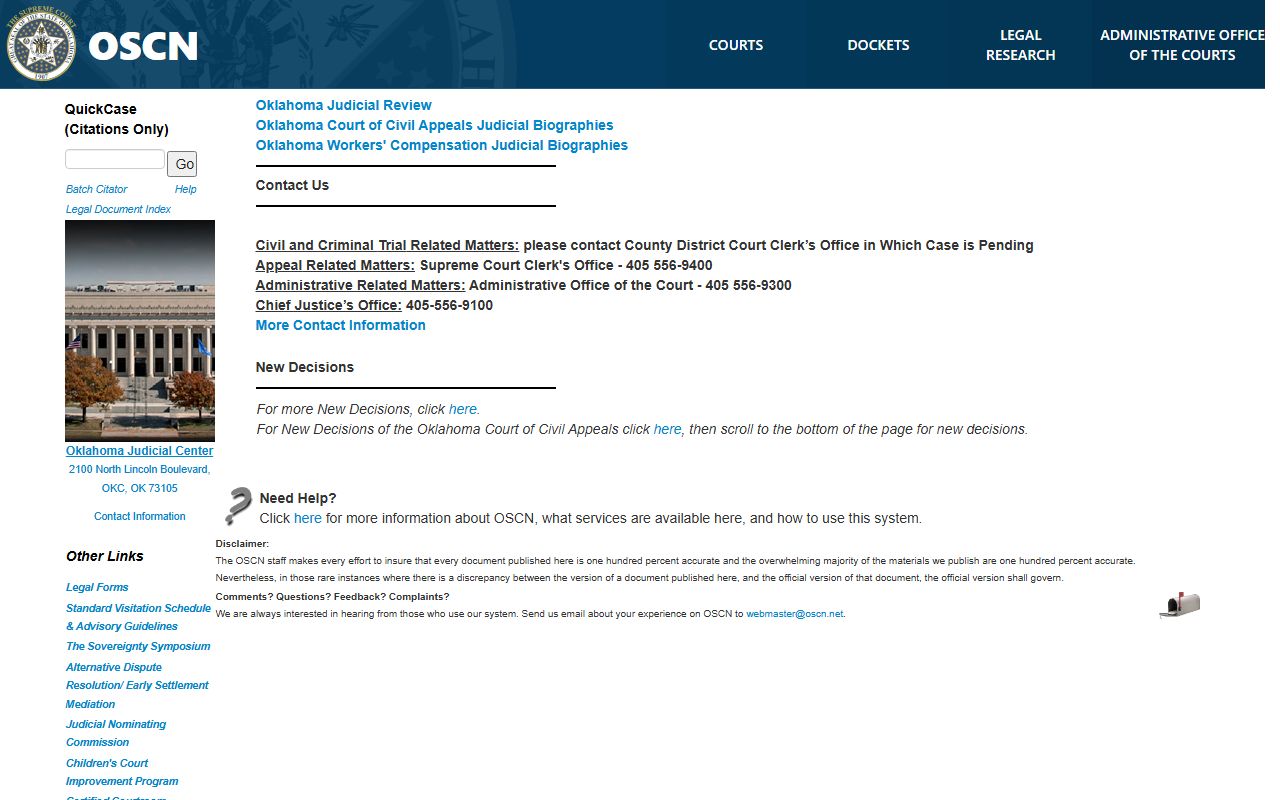
Court records here can show lis pendens filings and other actions that cloud a property title.
The Oklahoma County Clerk website below also serves as the UCC Central Filing Office for the entire state, which is tied to Oklahoma deed records through liens on real property.
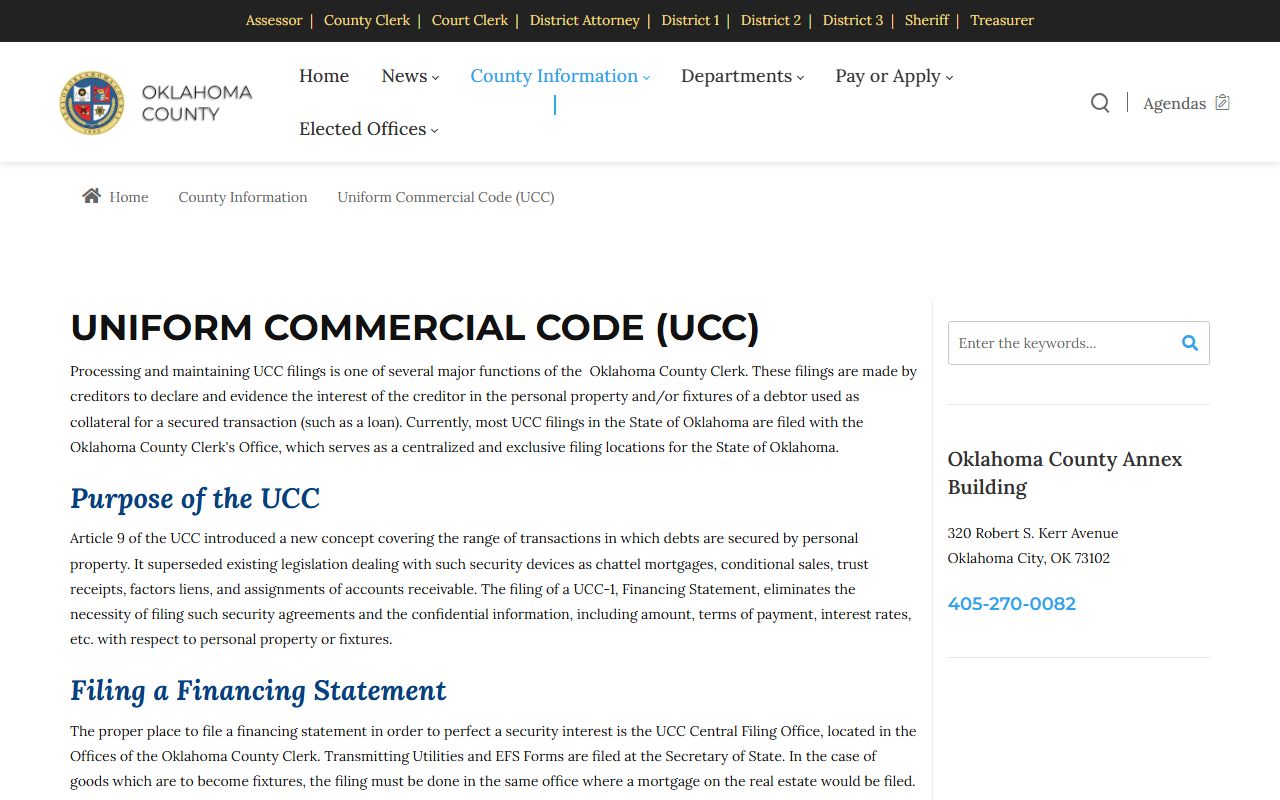
UCC records that touch real property get cross-referenced with deed records at the county level.
Protecting Your Oklahoma Deed Records
Property fraud is a growing concern across the state. Several Oklahoma counties now offer free fraud alert programs that send you a notification any time a document is recorded using your name. Tulsa County calls its system RecordRadar. You sign up with your name and parcel number. Payne County runs a similar Property Fraud Alert program tied to Senate Bill 925. Wagoner County uses Eagle Fraud Guard through the Tyler Technologies platform. Cleveland County offers FraudSentry. All of these are free to property owners.
County clerks also warn about common scams. Some companies send letters claiming they can get you a copy of your deed for $86 or more. The County Clerk's office can give you a certified copy for about $2.00 per page. Other scams involve fake tax lien notices or excess resale fund recovery offers after a tax sale. If you get a suspicious letter, call your County Clerk to verify before paying anything.
Browse Oklahoma Deed Records by County
Each of Oklahoma's 77 counties has its own County Clerk office that handles deed records. Pick a county below to find local contact info, search portals, and fee details for property records in that area.
Deed Records in Major Oklahoma Cities
City residents file deed records at the County Clerk in their county, not at a city office. Pick a city below to find out which county handles property records for that area.